Authorised Partner





SLA - Stereolithography
What Is Stereolithography?
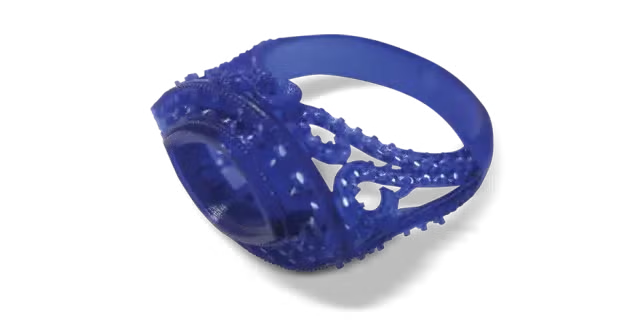
Stereolithography (SLA) is the first commercialized 3D printing technology, invented by 3D Systems' Co-Founder and Chief Technology Officer Chuck Hull in the 1980s. It uses an ultraviolet laser to precisely cure photopolymer cross-sections, transforming them from liquid to solid. Parts are built directly from CAD data, layer-by-layer into prototypes, investment casting patterns, tools, and end-use parts.
Once the SLA printing process is complete, SLA parts are cleaned in a solvent solution to remove any residual uncured resin from the part surface. Cleaned parts are then cured in a UV oven.
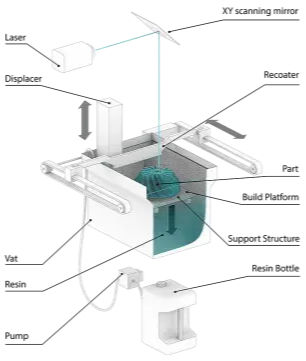
About Stereolithography (SLA)
SLA is all about precision and accuracy, so it is often used when form, fit, and assembly are critical. The tolerances on SLA parts are typically less than 0.05 mm, and SLA offers the smoothest surface finish of any additive manufacturing process. With the quality SLA can achieve, it is particularly useful for creating highly precise casting patterns (e.g., for injection molding, casting, and vacuum casting) as well as functional prototypes, presentation models, and form and fit testing. SLA technology is extremely versatile and can be used in any number of areas where precision is paramount.
SLA also offers a speed advantage when you require a variety of functional prototypes or quick access to casting patterns. SLA’s winning combination of speed and precision make it an excellent choice for evaluating prototypes. The accuracy of SLA means your prints are faithful to the final design, allowing you to identify and correct design flaws, collisions, and potential mass-manufacturing hurdles before production begins. SLA provides comparable characteristics to parts normally machined from polypropylene or ABS for low- to mid-volume production, and doesn’t require slow, expensive retooling for customization or required tooling changes. SLA also allows for reduced material costs, as any unused resin remains in the vat, ready for future projects.
Because SLA parts can require support structures, they often require post-processing, which opens opportunities for new part characteristics. SLA parts can be vapor honed, or bead or sand blasted, and can even be electroplated with metal, such as nickel. Electroplating makes SLA parts significantly stronger, and also makes parts electrically conductive and more dimensionally stable in moist environments.
SLA Applications
Delivering the smoothest surface finish of any additive manufacturing process, the quality of SLA parts makes this versatile technology great for:
-
Design verification models for appearance and proof-of-concept models
-
Functional prototypes and models for form and fit testing
-
Wind-tunnel test models
-
High clarity, transparent products and components
-
Complex assemblies
-
Under-the-hood components
-
Mass customization
Investment casting patterns
Custom assembly jigs and fixtures
Tools, moulds and dies
Cast urethane/vacuum casting master patterns
-
Surgical tools/guides
-
Dental appliances
-
Hearing aids
SLA Material Properties & Uses
Our Accura SLA resins offer the most accurate fit/form prototypes for design verification before committing to production. High accuracy and excellent surface finish makes these resins the preferred choice for designer models, engineering verification, and master patterns for silicone and rubber molds.
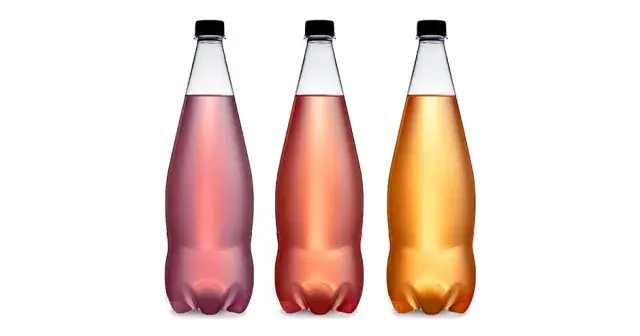
SLA 3D printing materials are available in a wide range of mechanical properties and can produce parts with characteristics similar to injection-molded ABS or polypropylene, suitable for applications such as snap-fit assemblies, automotive styling components, and master patterns, as well as higher-temperature applications and exceptional clarity. SLA materials for higher-temperature applications and clear materials with polycarbonate-like properties are also available. Our SLA material portfolio also includes biocompatible materials suitable for a wide range of 3D printed medical applications such as surgical tools, dental appliances, and hearing aids. Other SLA materials have been specifically formulated for sacrificial investment casting patterns, offering low ash creation and high accuracy, while also being expendable.
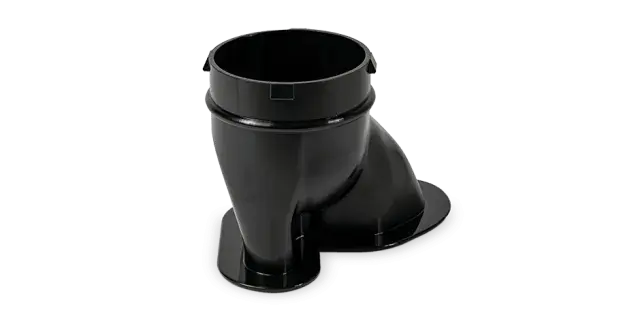
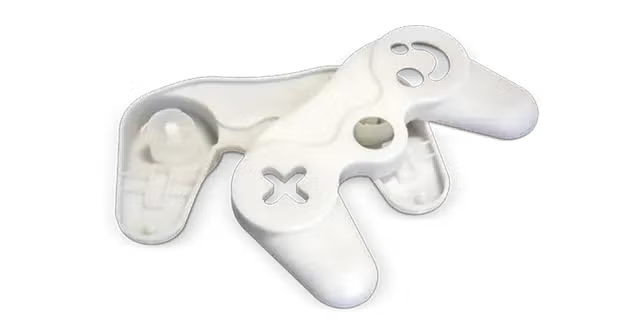

Expendable resins specifically formulated for QuickCast® sacrificial patterns for investment casting.

Heat deflection temperatures up to over 215˚C (419°F) offering exceptional performance under extreme conditions.