






Authorised Partner

3D Printing for Motorsports
Gain a competitive advantage and create faster motorsports innovations using the latest high-performance additive manufacturing tools and materials
Top racing performance requires robust, accurate parts. We collaborate to help you meet the innovation challenge, leveraging our decades of in-house additive manufacturing expertise and advanced material developments to help you build, test, and iterate more efficiently.
Using these capabilities and our industry knowledge, we’ll help you optimize new designs for high-performance and get effective solutions to the track faster
3D Motorsports Applications Built for Improved Productivity and Performance

Simplify the Production of Complex, High-Performance Parts
Parts such as air ducts, containers, tubes, protective covers, and couplings often require a high degree of flexibility and/or durability that traditional manufacturing methods can’t produce.
Our additive manufacturing technologies and materials enable better air and fluid management by making it possible to create durable parts with consolidated complex geometries, such as 3D printed intake manifolds. Use our solutions to improve internal system cooling, provide better component protection, reduce assembly, and avoid fluid leaks.
Solutions for Complex Air and Fluid Handling Challenges

Improve Part Durability Under Pressure
Your parts must be durable enough to withstand the demanding environment on the track. Our additive technology allows you to manufacture parts that will hold up against extreme temperatures, high energy, and varying frequency vibrations.
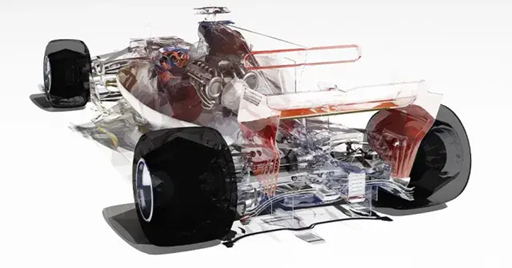
Achieve Precise Fits Inside Limited Spaces
Parts must be able to function at a high level within tight spaces. With 3D printing technology, you can create airtight components with smooth surfaces that fit and perform within limited volumes and have the durability to handle vibrations, temperatures, and other challenges.
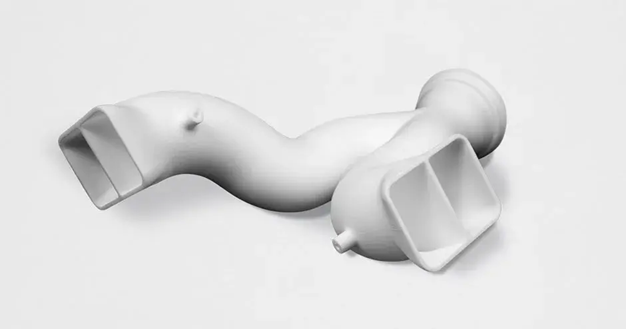
Simplify the Manufacture of Complex Parts
The challenge of packaging parts into tight spaces often requires complex, multicomponent assemblies. Our additive manufacturing solutions give engineers greater freedom to create designs that consolidate these assemblies into fewer components, significantly simplifying assembly and improving performance and quality.
Optimize Weight, Force, and Inertia More Effectively
Race cars are subject to a variety of forces, giving you numerous opportunities to design and improve their metal structural components.
Using our advanced metal additive manufacturing solutions, you can achieve greater control over the race car strength-to-weight ratio of metal parts, often reducing the overall number of components. We can also help you accelerate testing and iteration, enabling you to build higher-performance vehicles more quickly and efficiently.

Solutions for Metal Structural Component Challenges

Meet High-Performance Demands
Race car structural components must be able to perform under extreme conditions. Additive manufacturing allows you to optimize the strength-to-weight ratio for better performance and significantly reduce the time it takes to iterate. The result allows you to identify failures quickly and validate designs faster.
Design for Tight Packaging
Structural systems must often be packaged within very constrained environments. Additive manufacturing meets this challenge by giving you the design and manufacturing flexibility necessary to create parts, such as wishbones and struts, that fit and function within strict dimensions.

Better Inertia Management
Metal structural systems must be able to withstand significant rotational forces. By allowing you to control the race car strength-to-weight ratio more closely, additive manufacturing can give you more control over the forces of inertia, helping you increase efficiency and durability.
.jpg)
Reduce Component Count
Because metal structural systems must be able to handle high stress, building them out of multiple components increases the number of possible failure points. Our engineers can help you reduce this risk by working with you to create durable, integrated parts that contain fewer components.

Maximize Your Wind Tunnel Investment
Making the most out of your wind tunnel investment means testing and iterating as many designs as possible. Having our aerodynamic 3D printing solutions on-site allows you to produce multiple iterations in parallel, reducing build time from days to hours.
Our experts also have considerable motorsports experience with some of the world’s top teams and can thus help you create durable, aerodynamic, precise new components to maximize your time in the wind tunnel.
Solutions for Wind Tunnel Testing Challenges

Produce and Test Wind Tunnel Parts Faster
Wind tunnel access is often restricted, which makes it necessary to quickly iterate designs and apply them to new models. Using our additive manufacturing equipment on-site, you can 3D print multiple iterations of accurate parts in hours, allowing you to rapidly improve designs and increase vehicle performance.

Replicate Finished Part Quality
When testing aerodynamics, prototype components must mimic the design and surface features of finished parts. Our additive manufacturing solutions can produce aerodynamic wind tunnel testing parts with excellent surface accuracy and quality, as well as the strength and durability to maintain these properties during testing.

Innovative Sensing Solutions
During aerodynamic wind tunnel testing, it’s critical to collect as much data as possible without affecting the design or slowing the iteration process. Our additive manufacturing technologies enable you to seamlessly include integrated pressure taps when printing all components, allowing you to maximize data collection while ensuring that the assembly process remains simple and fast.
Perfect Your Aerodynamic Performance Through Rapid Iteration
Using our extensive additive manufacturing expertise and deep process knowledge in motorsports, you can maximize your limited wind tunnel testing time by producing and iterating test fins, air vents, bargeboards, and other race car body exterior parts quickly and efficiently.
Produced in hours and made from durable plastic materials, such as carbon fiber, our 3D printed parts can help minimize drag and lift, maintain stability, and increase performance.

Solutions for Metal Structural Components Challenges

Accelerate Testing
Motorsport teams often feel constrained by the amount of wind tunnel testing time they have. With our advanced technology, our engineering consultants enable you to produce more iterations in less time, making it possible to improve your designs rapidly.
Enhance Performance
The extreme conditions of the track require enhanced strength and integrity. Our additive manufacturing solutions allow you to produce parts durable enough to withstand on-track forces so that you can optimize their aerodynamics and air flow.
Improve Surface Quality and Accuracy
Reliably testing aerodynamic surfaces requires a high level of precision for producing and finishing components. Our additive technology enables you to produce parts with excellent surface finishes while retaining their accuracy, durability, and strength.

Optimize Fluid Flow, Package Space, and Manufacturing
Manufacturing aids are often used for short-run production in motorsports and customizing jigs and fixtures for specific parts. Manufacturing aids also assist with streamlining production and shortening the time required to complete assembly.
Our additive manufacturing solutions allow aids to be printed quickly and kept on hand as replacements to keep the manufacturing flow running smoothly.
Solve Your Air and Fluid Handling Challenges

Stable Supply of Replacement Jigs and Fixtures
Jigs and fixtures can wear or break during a critical production run. Producing replacement jigs and fixtures with additive manufacturing ensures that parts can be built quickly and stored in inventory, saving time, costs, and labor. Batch production of parts can be completed in mere hours.

Rapid Design Iteration
The tight tolerances of manufacturing aids are critical to their effectiveness. Producing a fixture with friction points through traditional means can be difficult to achieve, modify or repair quickly. The ability to produce iterative designs with additive manufacturing and adhere to strict tolerances improves the manufacturing performance.

Durability and Rigidity of Jigs and Fixtures
Subject to significant stress and forces, jigs and fixtures must maintain their accuracy, strength, and rigidity to remain effective. With additive, when manufacturing aids begin to exhibit wear and tear, they can be easily replaced with new parts that have the same durability and accuracy as the previous parts.
Maintain High Performance with Durable Corrosion Resistant 3D-Printed Components
Fluid and energy management in motorsports is fundamental to maximizing performance. Part quality and integrity are also essential as parts must possess the strength to combat to resist corrosive materials, including various automotive fluids, as well as high temperatures and harsh conditions.
Our metal additive manufacturing solutions enable your team to design and produce high-quality, complex parts capable of exceeding your performance expectations.

Solving Metal Energy and Fluid Management Challenges

Stability in Harsh Environments
Parts are often packaged in challenging environments with high temperatures, temperature cycling, chemical exposure, and high energy vibrations. Part failure can lead to catastrophic issues with remaining on and returning to the track. Metal 3D printing provides solutions with parts that can remain stable in harsh conditions.

Constrained Packaging Space
Parts must often fit and function in tight spaces. Metal additive manufacturing can easily produce complex metal 3D-printed parts to work within these constraints and maintain high performance. Moreover, designing curves, angles, and channels is simple and provides the design freedom for unique part creation.

Durability Over Time
Parts in racing vehicles must remain not only stable in extreme temperatures but also free of corrosion and degradation. Parts that break down over time can impact performance significantly. Metal additive manufacturing utilizes a wide range of materials to overcome such challenges and meet these needs.

Manufacturing Complex Parts
Parts handling fluids or managing energy are often intricately designed, with curves, turns, and narrowing tubes. These complicated shapes can be difficult to manufacture accurately using traditional means. Metal 3D printing can produce complex parts as efficiently as simple ones, offering various solutions in part design.

Accelerate the Production of Accurate Master Patterns
During the testing and iteration stages of finished metal part production, the ability to quickly cast metal parts is critical. Manufacturing master patterns for investment casting with traditional means was previously a time-consuming process, however, our additive manufacturing methods offer motorsports engineering and manufacturing teams innovative solutions to rapidly manufacture precise master patterns which are then used to cast high-performance metal parts.
The QuickCast stereolithography (SLA) process that 3D Systems developed for investment casting delivers lightweight, accurate master patterns at unprecedented speed and quality. The QuickCast process is ideal for the motorsports market, which often requires low volumes of highly complex parts.
Solve Your Energy and Fluid Management Challenges

Turnaround Time
Casts, especially for complex parts, can be expensive and require weeks to produce. Utilizing additive manufacturing reduces the time needed to produce patterns to hours, allowing designs to be tested and iterated quickly, thus significantly shortening the process for achieving a finished solution.

Enhance Performance
The extreme conditions of the track require enhanced strength and integrity. Our additive manufacturing solutions allow you to produce parts durable enough to withstand on-track forces so that you can optimize their aerodynamics and air flow.

Accuracy
Casts produced through conventional means often struggle to produce parts with complex designs or intricate patterns, such as honeycombs or baffles. With 3D printing, quick casting solutions can be simple or complex since additive manufacturing easily produces geometries with different intricacy levels.

Manufacturing Ease and Workflow
Waiting for cast metal parts to be produced and delivered can disrupt the production workflow and waste valuable time in the process. With additive manufacturing, quick-cast patterns relieve that bottleneck and keep the workflow moving smoothly, without interruptions.
Durable Parts that Withstand Tough Conditions on the Racetrack
The powertrain and engine area is a constrained space in the core of a race car, key to delivering high performance. Designing and packaging parts for this area is a challenge as parts mounted in this environment must withstand harsh conditions such as heat cycling, vibrations, and corrosive fluids.
Our additive manufacturing solutions enable engineers to design components that fit into these constraints and withstand such conditions. Through advanced material science and incredible accuracy, 3D Systems maximizes automotive performance and drives success on the track.

Solve Your Powertrain and Engine Area Challenges

Rapid Iteration
Time is a critical constraint for motorsports teams. Design, testing, and iteration must be completed rapidly to meet race schedule demands and compete with other high-performance teams. Producing parts in hours shortens that cycle significantly and frees up other valuable resources.

Design Degrees of Freedom
Additive manufacturing allows teams to develop optimized propulsion and control systems with greater complexity. Whereas traditional manufacturing methods and constraints limit engineers’ ability to design at the next level, additive manufacturing can bring almost any design, no matter its complexity, to life.

Packaging Space Versus Performance
Packaging space is limited in the engine compartment; trade-offs between the functionality of structural housings, the delivery of fluid and energy components, and the packaging volume are therefore common. However, compromise is no longer necessary as parts that have fit and high function can be produced with our additive manufacturing solutions.

Harsh Packaging Environment
The engine and powertrain area is packaged in extremely challenging environments with high temperatures, chemical exposure, and severe vibrations. Materials such as metals and plastics that can withstand these stresses are needed to maintain exceptional performance.